We spent $175 on ChatGPT's ad beta. Here is what it measures, and what it doesn't.
We ran a campaign through OpenAI's ChatGPT ad beta for a week. Here is every metric the Ads Manager reports, and the one it will not show any business.
Dan Johnson
Co-Founder · July 6, 2026 · 4 min read
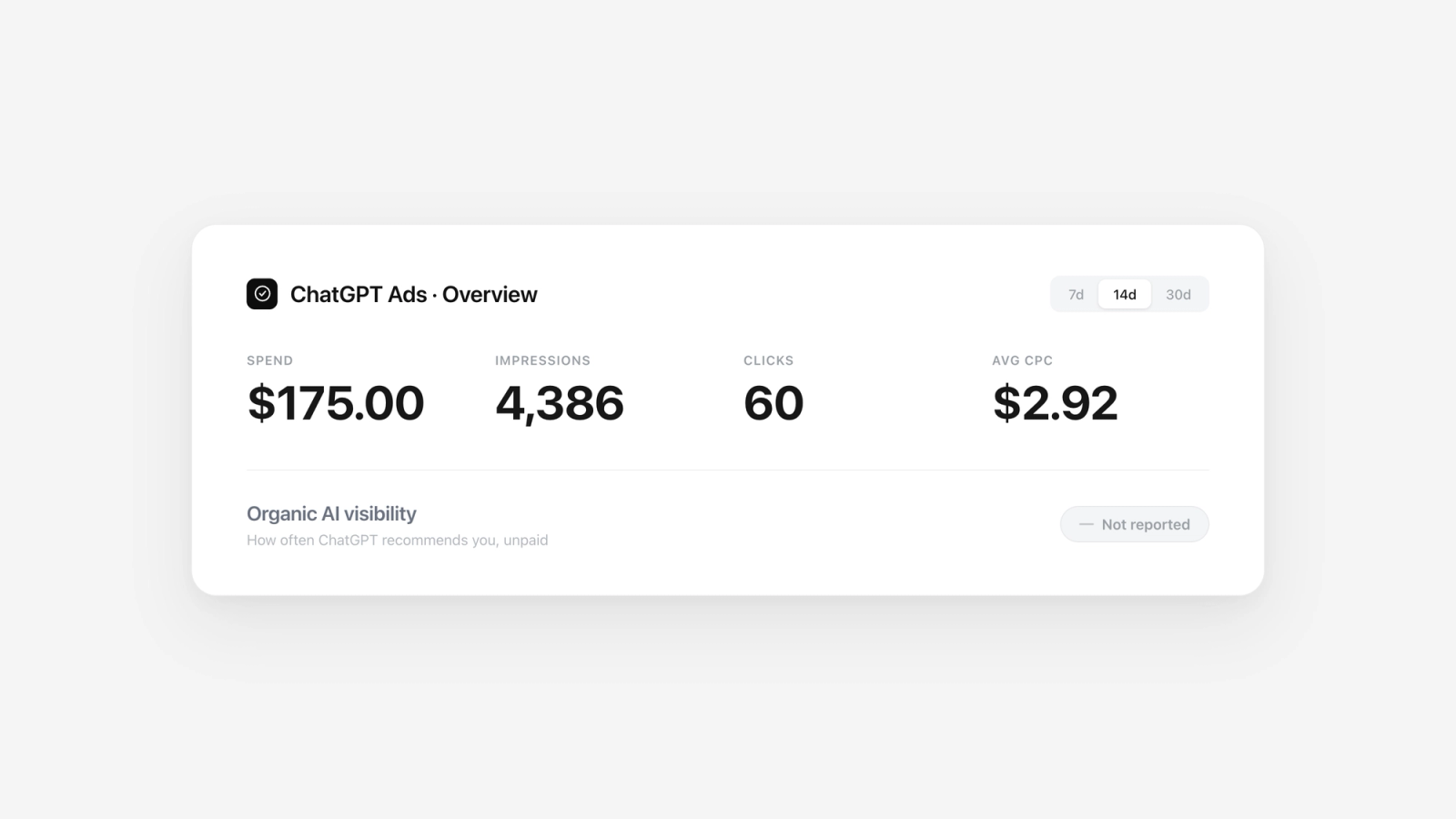
OpenAI's Ads Manager is in open beta. It is self-serve, there is no minimum spend, and the whole thing wears a “Beta” badge. So we ran a real campaign through it for a week and wrote down every number it gave back. We spent $175, served 4,386 impressions, and got 60 clicks. Here is the full teardown: what the dashboard reports, whether the numbers hold up, and the one metric it will not show any business.
What we ran
One campaign, built in the Ads Manager in a few minutes. Objective: clicks. Location: United States. Budget: $25 a day. It ran from June 29 to July 6. The ad pointed at our free AI visibility scan. Billing runs on a threshold, the same as most self-serve ad platforms.
Targeting is not the model you know from Google or Meta. There are no keywords to bid on and no demographic checkboxes. You pick a location and an objective, and OpenAI matches the ad to conversational context. OpenAI has called this intent-based rather than profile-based, and told Cannes Lions that roughly 20% of ChatGPT queries carry commercial intent[1].
What it measures
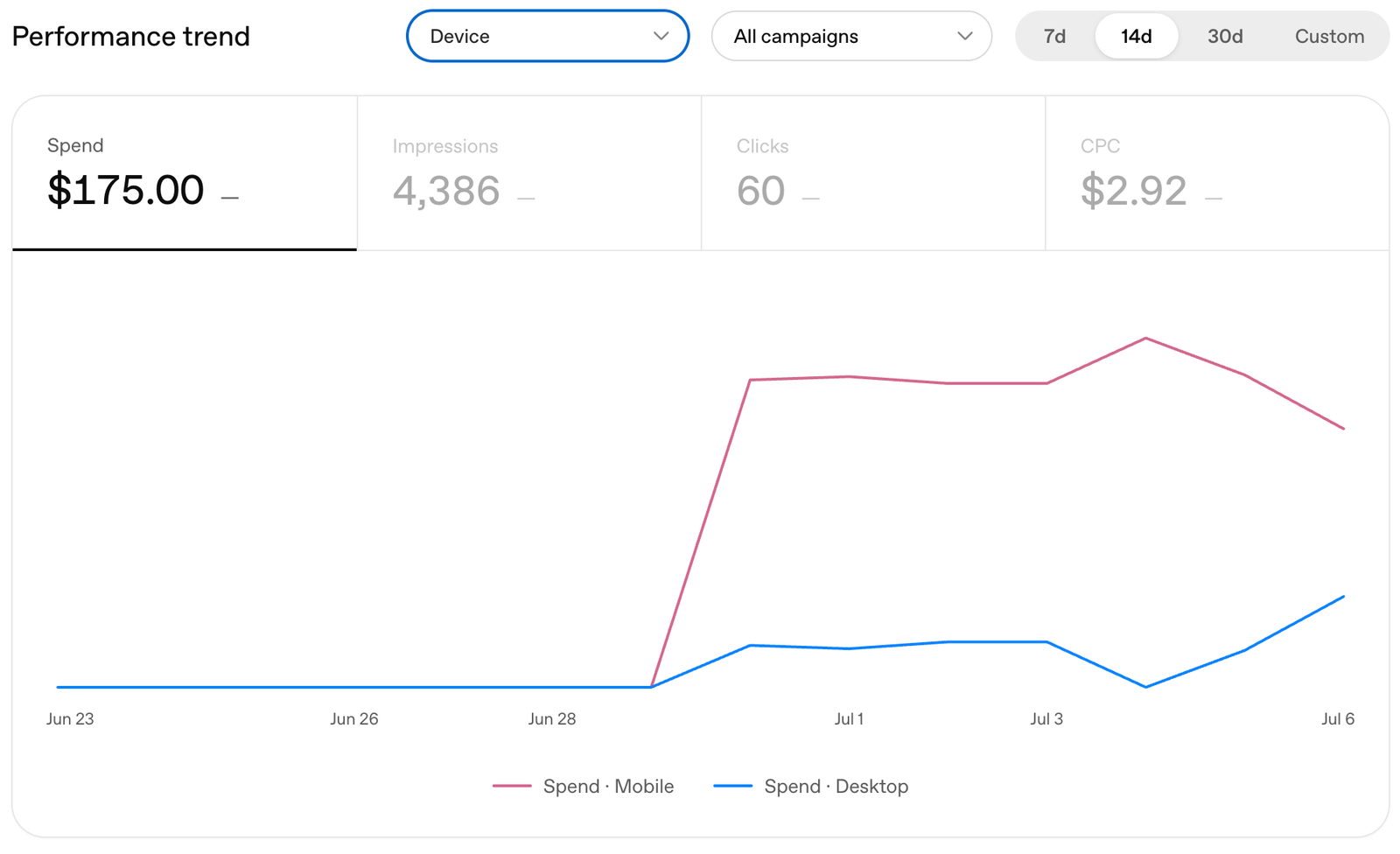
The reporting is clean, minimal, and familiar. The Overview shows one performance-trend chart across a 7, 14, or 30 day window: spend, impressions, clicks, and CPC. The Campaigns view breaks the account down by campaign, ad group, and ad. Ours, over the week:
- Impressions: 4,386
- Clicks: 60
- Conversions: (blank)
- Spend: $175.00
- CTR: 1.37%
- Avg CPC: $2.92
- Avg CPM: $39.90
The math checks out, which is a good sign for a beta. 60 clicks on 4,386 impressions is a 1.37% CTR. $175 across 60 clicks is a $2.92 average cost per click. $175 across 4,386 impressions is a $39.90 CPM. You can chart any metric over time, filter by campaign, and export to CSV. There is also a change-history log that records every edit to a campaign, ad group, or ad. That is close to the starting set you would expect from any ad platform. These are beta auction numbers on a small budget, so treat them as a snapshot, not a benchmark.
What it takes to measure a conversion
Our Conversions column stayed blank, and that is the honest state of the product, not a failure of the campaign. Out of the box you get impressions, clicks, and spend. To measure anything past the click, you build the plumbing yourself: create a data source, define a conversion event, implement and log it, then link the event to a campaign. Attribution is available, but it is bring-your-own. There is also a product-feed path over SFTP for shopping-style ads.
Can you trust the clicks it reports?
This is where it gets interesting. OpenAI reports the clicks, and you cannot see or confirm that number from the outside, because it lives only in OpenAI's dashboard. So we did the obvious thing and checked it against our own analytics, counting the sessions that actually reached our website from the campaign.
They did not match, and they are not supposed to. A reported click and a tracked session are different events. Some clicks never become a session: the tap opens in ChatGPT's in-app browser, which often blocks the cookies and scripts analytics rely on, or the page closes before it loads, or the click was a bot. In our run, spend skewed heavily toward mobile placements, which fits that in-app-browser explanation. In our checks, the platform's click count ran ahead of what we could independently verify. The gap itself is normal. The lesson is not: if you want to know how many real people your ChatGPT ad sent you, you have to bring your own measurement, because the platform will only ever show you its side of it.
The number it will not show you
Here is the part that matters if you run a business rather than a campaign. OpenAI will tell you, to the click, how a paid ad performed inside ChatGPT. What it will not tell you, or any business, is how often ChatGPT recommended you for free, in an ordinary answer, when nobody paid for the placement. There is no organic view. No count of the times the model named you, no record of which questions surfaced you, no reason attached.
That is the shape of it. The measurement exists on the paid side and stops there. OpenAI built an analytics dashboard for advertisers before it built any visibility layer for the businesses the model talks about every day. Discovery has moved to AI, and the meter runs only when you are buying ads.
That gap is the reason GeoReputation exists. We run the prompts your customers actually run, capture the verbatim answers across ChatGPT, Google AI Overviews, Perplexity, and more, and show you where you stand and what to test next. It is the organic half of the picture the ad platform leaves out.
If you want to see the free side of your own AI visibility, run a scan.
Methodology and limits. One self-serve Ads Manager campaign, clicks objective, $25 a day, June 29 to July 6, 2026: 4,386 impressions, 60 clicks, $175 spend. The Ads Manager is labeled Beta, so the metrics, interface, and pricing will change, and these are small-budget auction numbers, not a benchmark. Context on formats, targeting, and access is from OpenAI and reputable trade coverage.
References
- [1]How OpenAI is positioning ChatGPT ads at Cannes Lions — Marketing Divehttps://www.marketingdive.com/news/how-openai-positioning-chatgpt-ads-cannes-lions-debut/823476/
About Dan Johnson
Dan Johnson is the co-founder of GeoReputation, where he handles the engineering. Posts on this blog are usually grounded in data pulled live from the platform.