
How Google Redefined What Counts as a Business
Google now treats a business as a verified set of accounts rather than a website. AI systems reach the same conclusion by guessing.
Molly Stephens
Business Development · August 31, 2026 · 8 min read
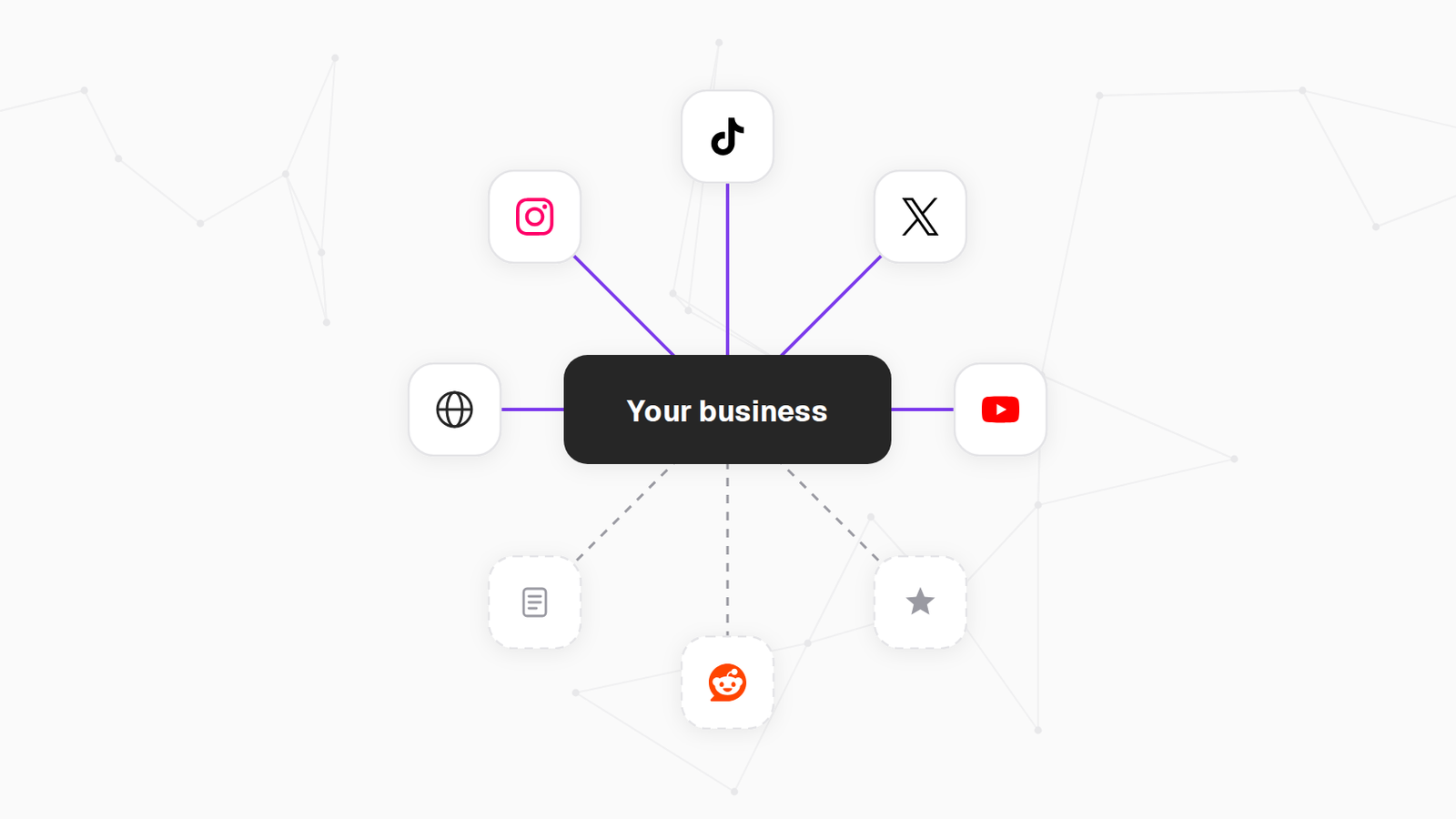
Before any system can recommend a business, it has to work out what the business is. A company exists across the internet in pieces: a website, a few social accounts, listings in directories, reviews on several sites, and mentions on pages the company has never touched. Nothing marks those pieces as belonging together. A system must decide that they do, and must separate them from the pieces belonging to a different company with a similar name in a neighboring town. Only then can it say anything at all about the business.
Whatever a system settles on is what it then treats as the company. I will refer to this as "the unit of visibility."
For twenty years, in every tool Google offered to businesses, that unit was the website, and in July it changed.
On July 7, Google added platform properties to Search Console, rolling them out gradually over the weeks that followed[1]. A business can now connect an Instagram, TikTok, X, or YouTube account and see the same reporting Search Console has long provided for websites: impressions, clicks, click-through rate, average position, and the searches behind them, across Search, Discover, and News[2].
Nearly all the commentary has been about that reporting and about one inference drawn from it. The reasoning runs like this: Google would not build measurement for content it considered unimportant, so the dashboard reads as an admission that social posts are search results. That reasoning is very likely right, but it describes the smaller half of what happened, treating the reporting as the point and the step before it as paperwork.
Change in verification
Until July, Search Console asked every business the same question at setup, and would accept only one kind of answer: proof that the business controlled a given domain. A business proved this by adding a record to the domain's settings or uploading a file to the site. Such proof establishes ownership of a web address and nothing else. Everything Search Console reported afterward was organized around that address, including which of the site's pages Google had indexed and which searches had pointed toward it. The business, as far as the product was concerned, was a website.
Platform properties cannot work this way. The content sits on servers the business does not own, so there is no address to prove. Google asks for something different instead. The business signs in to the account and grants access, and Google accepts that as proof that the account belongs to the business.
The change looks at first like a workaround for an awkward case, but it does more than that. Once a business has done this a few times, Google holds a website, an Instagram account, a TikTok account, and a YouTube channel, each one confirmed by the same person as belonging to the same company. Those confirmations are not four separate reporting setups that happen to share a login. Together they are a statement about who the company is, a set of scattered properties that Google now knows to be one business.
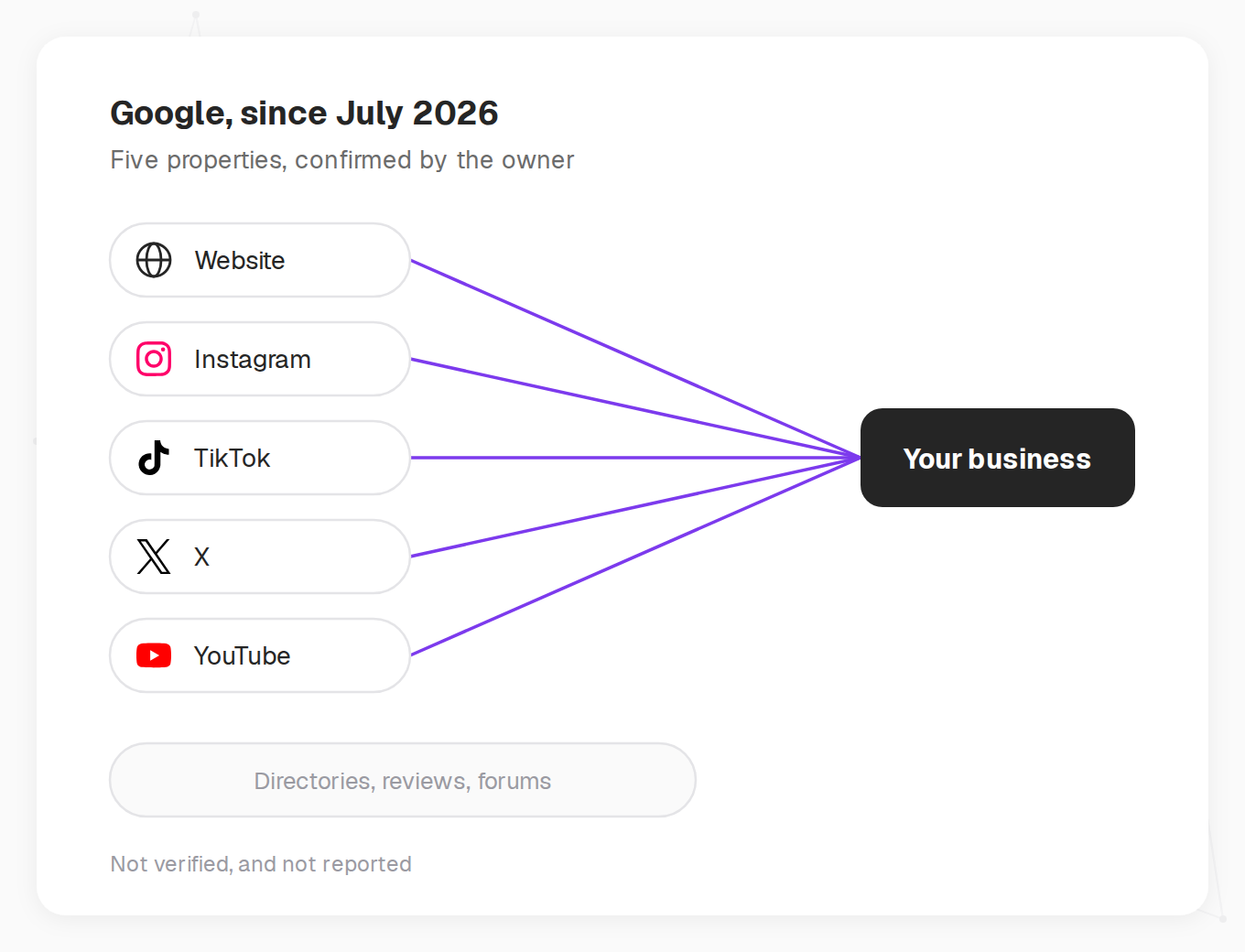
Google built that record and released a performance dashboard as the visible part of it. In Google's own tooling, the unit of visibility is no longer the website.
Why AI systems face the same problem
This matters beyond Google, because the same problem faces any AI system before it can recommend anyone.
Consider a model asked for the best commercial roofer in Columbus. It does not pull up a page and rank it. It gathers what it can find: a website, a directory listing, a set of reviews, a discussion thread, and a video. Then it has to judge whether all of that describes one roofing company or several. Only once the pieces hold together as a single business can the model say something about it with enough confidence to put that claim in an answer.
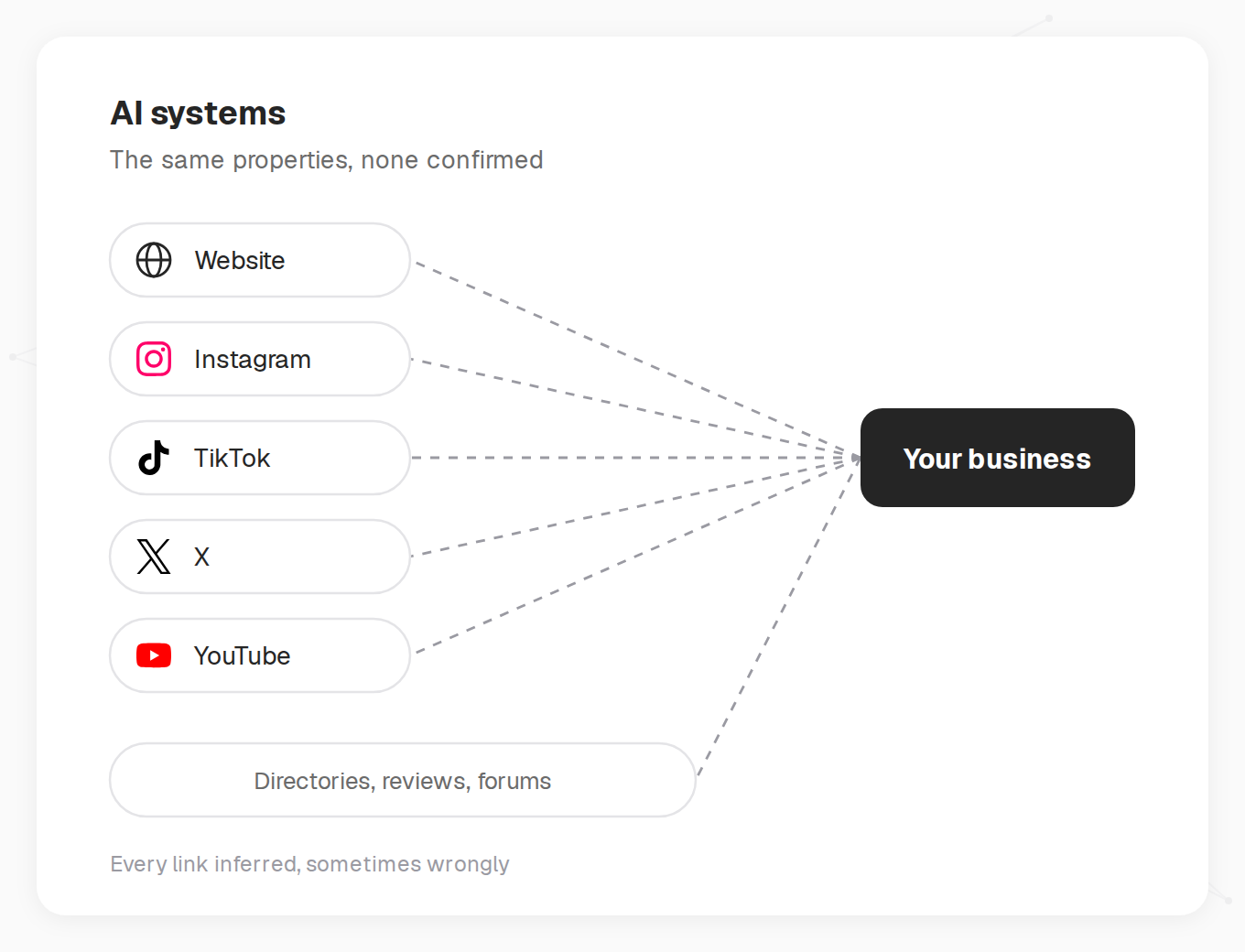
The judgment comes before the recommendation, which means a failure at the first step ends the matter. A company whose pieces fit together cleanly is something the model can talk about. A company whose pieces do not fit remains a pile of fragments, and fragments are not recommended. The reason has nothing to do with the quality of the content. A system that cannot establish who a company is has no grounds for vouching for what it does.
This is the argument about legibility, moved up a level. Legibility, as we have used the term, is about whether a page says what a business does in words a model can reuse. The question here comes earlier: whether the pages saying those things are recognizably one business to begin with. The first is a question about documents, the second about identity.
What follows in practice
Two things follow, and neither is the dashboard.
The first is that saying the same thing everywhere has stopped being a matter of brand discipline and become a requirement for being recommended at all. A company might describe itself one way on its website and quite differently across its listings and social accounts. The cost is not an untidy public image, but evidence handed to a system that these may be different businesses, or that the picture does not hold together. Neil Patel, discussing the announcement in a recent video, notes that inconsistency of this kind reads to a machine as risk[3].
The mechanism is better described as a failure to assemble than as a judgment against the company. The company is not weighed and found wanting; it never becomes something the system can weigh.
The second is that pulling those pieces together is now deliberate work rather than something that happens on its own. It means the same name, the same words for the category, the same description of services, and the same claims about location on every property the business controls. Platform properties give a business one place to state those connections to Google directly. AI systems offer nothing comparable. They have to infer the connections from public evidence, which is why the consistency of that evidence matters as much as its content.
What the reporting does not cover
Platform properties report how Google surfaces content from four platforms. They do not report how that content performs on the platforms themselves, and they do not report AI systems at all, even though those systems are reading much of the same public evidence Google has begun to organize.
That limit is worth stating plainly rather than treating as a flaw. Our own measurement work put the same questions to a single AI provider two ways, through its developer API and through the chat interface a customer would actually use. Across 14,354 paired captures, the two agreed on where the answer came from 22% of the time.4 That is the condition past the edge of Search Console. There is no dashboard to open and no single number to trust, and the observation has to be built before it can be read.
What a business can assert
Platform properties give a business one place to state these connections to Google. No AI system offers an equivalent, and none is likely to, because none of them asks businesses to sign in. What remains is publication. The same claim can be made in the open, in a form built to be read by machines.
The mechanism is called sameAs, and it is simpler than the name suggests. A website has no ordinary way of telling a machine that a particular Instagram account belongs to it. A person infers that from a matching name and a familiar logo. A machine has to guess, and it guesses wrong often enough to matter.
sameAs stops the guessing. It is a short list added once to a site's code, naming the other addresses where the same business lives. We covered the wider practice in an earlier piece on structured data; this is one line of it:
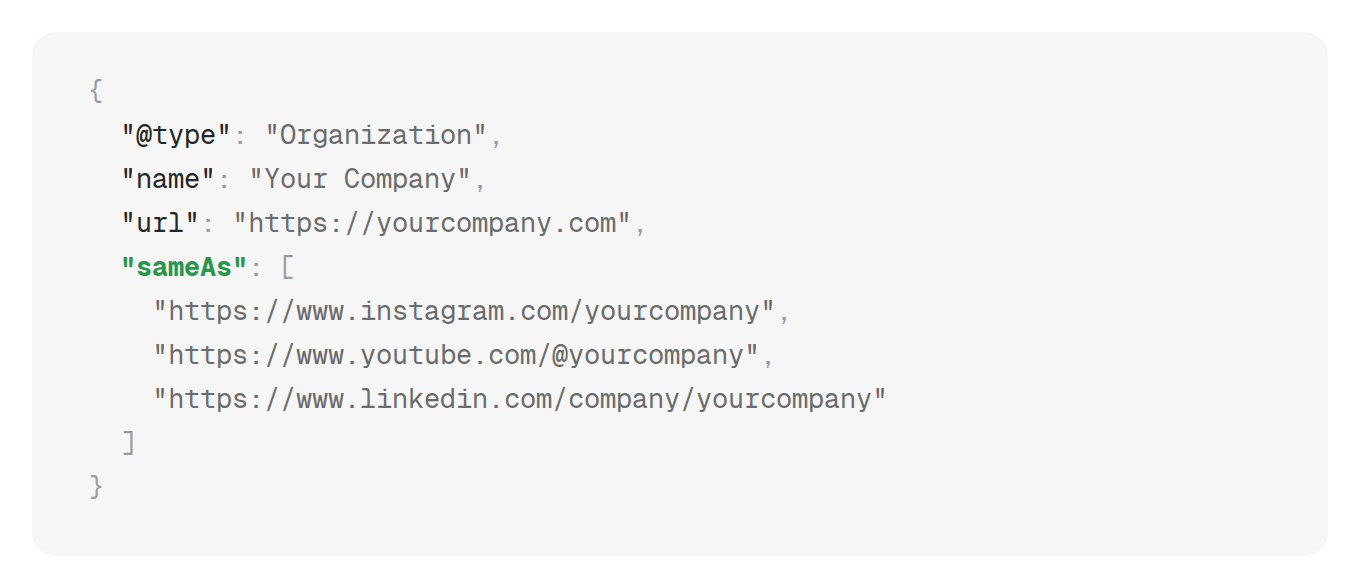
Read it as a sentence. The company described on this page is also the account at each of those addresses. Nothing about it is more complicated than that, and adding it is a few minutes of work for whoever maintains the site.
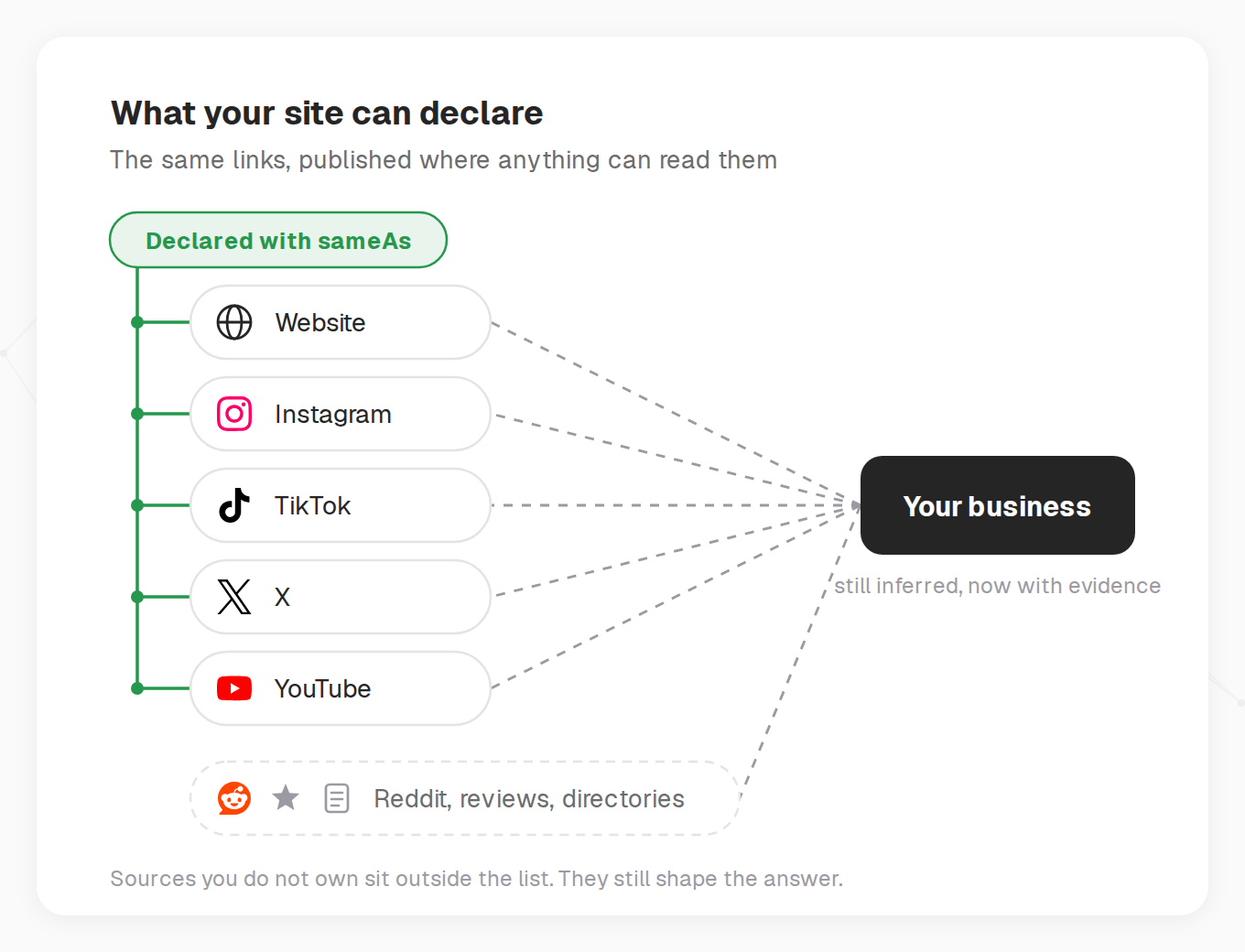
What has changed is the job it does. sameAs was written to help search engines tell similarly named businesses apart, and that is now the first thing an AI system has to do before it can recommend anyone.
The difference from platform properties is worth stating precisely. Google's version is private. An owner signs in, and Google confirms the connection. The published version is public and unconfirmed, readable by anything that visits the page.
Because a business writes its own code, a machine treats sameAs as a claim rather than a fact and weighs it against whatever else it finds. The claim is stronger when the other end agrees, which in practice means the profiles link back to the site. So it is weaker as proof than what Google now holds, and wider in reach, and for AI systems it is the only version on offer.
Knowing whether it worked is the harder half, because nothing reports whether a machine has correctly worked out who you are. The observation has to be built. That means running the same prompts repeatedly against the interfaces customers actually use, then recording both whether the business is named and which other websites are cited alongside it. A business the machine can place appears under its own name with its own sources attached. One it cannot place appears intermittently, or attributed to a similarly named firm in a neighboring market.
The announcement is not valuable because it closes a measurement gap. It is valuable because Google has published what it now takes a business to be, and the answer is a confirmed set of properties rather than a website. AI systems work from a similar answer without anyone confirming it for them, guessing at connections Google can now simply look up. The businesses those systems recommend will tend to be the ones that make the guess easy.
That is the work we built GeoReputation to do. We run every prompt three times against ChatGPT, Gemini, and Perplexity as customers see them rather than through the APIs, and we record which third-party domains get cited whenever a business is named. We also crawl the site's structured data to see what it currently declares about itself. If you want a free read on whether AI systems can tell who your business is, run a scan.
Powered by GeoReputation Visibility Intelligence.
References
- [1]Moshe Samet, "See how content from social and video platforms performs on Google Search," Google Search Central Blog, July 7, 2026.https://developers.google.com/search/blog/2026/07/search-console-social-video-platforms
- [2]"Platform properties," Search Console Help, Google.https://support.google.com/webmasters/answer/17148418
- [3]Neil Patel, video on search everywhere optimization, Instagram, 2026.https://www.instagram.com/reels/Db8IDjYj4hI/