
What an AI citation is worth
ChatGPT cited a local tile company's own website when buyers asked who to hire. What that citation is worth in new business, and why content and structure decide who AI recommends.
Dan Johnson
Co-Founder · July 1, 2026 · 4 min read
Last week I watched ChatGPT hand a small business a customer. A buyer asked it who the best tile installer near them was, and the answer came back with a name, a short pitch, and a link straight to that company's website. No ad to buy. No ranking to claw for. Just the business, offered up as the answer to a question someone was already asking. The link even carried ChatGPT's own tag, utm_source=chatgpt.com, so there was no guessing where the visit came from.
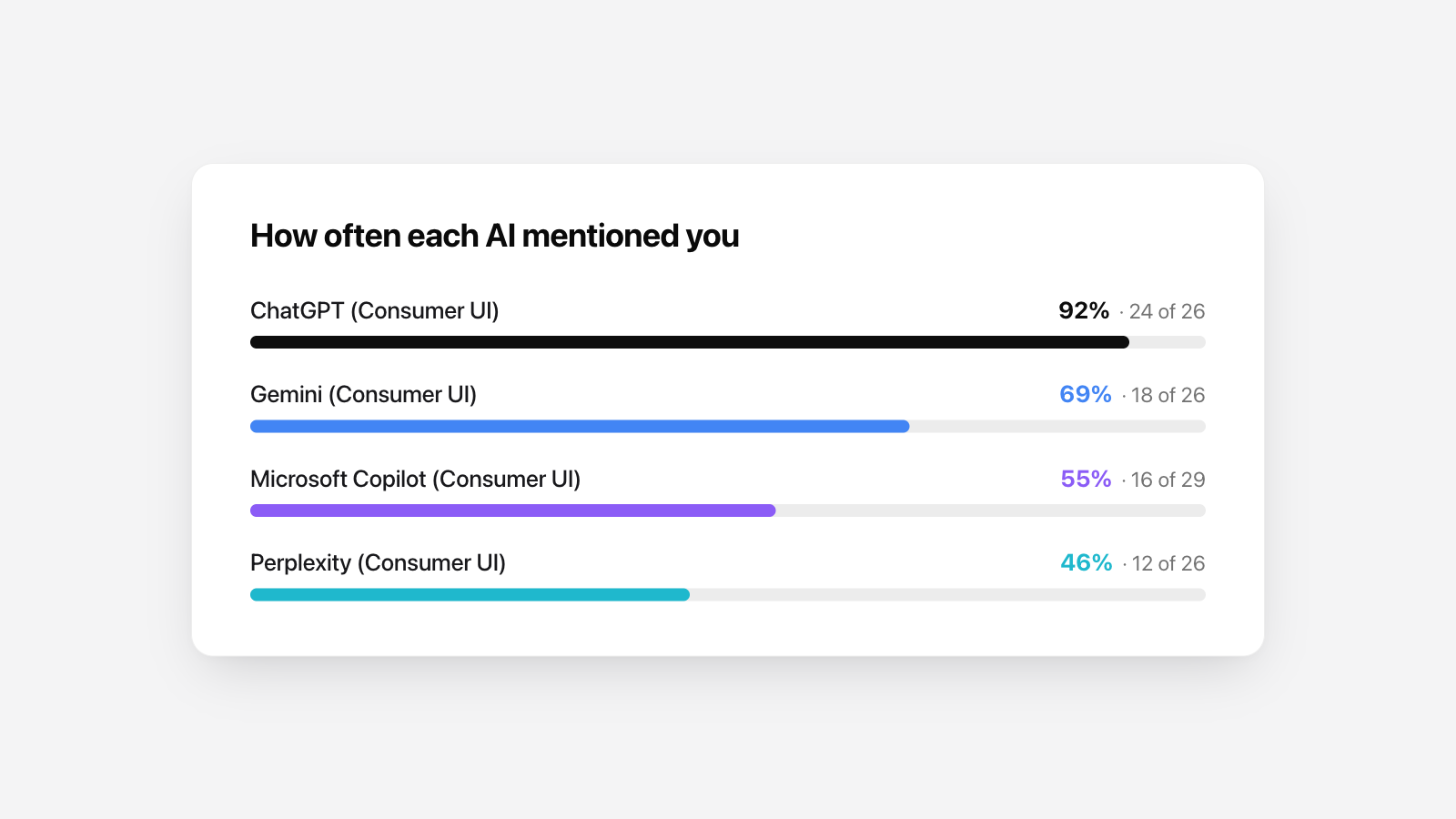
We measure this for a living, so I could watch it happen across every major assistant, not just ChatGPT. That same company's website was cited by ChatGPT, Microsoft Copilot, Google AI Overviews, Google Gemini, and Perplexity, on the real questions buyers ask, like "tile contractor for new home builders in central New Jersey." In its most recent scan, its website showed up in 38 of 78 AI answers we ran (49%).
That is one small business showing up at the exact moment a customer decides who to hire. That moment is where new revenue starts. Here is why it matters, and what it is worth:
Discovery moved, and the numbers are not close
People now ask AI the questions they used to type into a search box. ChatGPT reached 900 million weekly active users[1] (OpenAI, February 2026). About 49% of US adults report having used an AI chatbot, up from 33% a year earlier[2] (Pew Research, survey of 5,119 US adults, February 2026).
Google AI Overviews, the answer box at the top of results, reached 2 billion monthly users[3] (Alphabet Q2 2025 earnings), and 60% of US adults say they read those AI summaries[2] (Pew, same 5,119-person survey).
The behavior shift is measurable. In a tracked-browsing study of 900 US adults across 68,879 searches, when an AI summary appeared people clicked a traditional result in 8% of visits, compared with 15% when no summary appeared[4] (Pew Research, March 2025). The answer is becoming the destination, not the list of blue links under it.
Getting cited is not the same as ranking
Ranking well on Google does not mean AI will cite you. Across 4,706 queries, the sources AI Overviews cited overlapped with the top 10 organic results less than 50% of the time[5], a finding corroborated by general SEO tools (Ahrefs measured 38% overlap[6], and BrightEdge roughly 17%). AI answers pull from a different, partly separate pool of sources.
What moves that pool is on-page content and structure. In the peer-reviewed GEO: Generative Engine Optimization paper, benchmarked on 10,000 queries, adding quotations, statistics, and cited sources to a page raised its visibility in AI answers by up to roughly 40% on the paper's word-count metric, while a merely authoritative tone helped far less, about 12%[7]. A separate December 2025 study of 55,936 queries across six AI search engines found the pages AI favored were more readable and more hierarchically structured[8]. What is on your website, and how it is structured, changes whether AI recommends you.
The goal is net new revenue
The goal here is net new revenue. When someone asks AI who to hire and your business is the name that comes back, that is a customer walking toward your door, and you did not run a single ad to get them there. That is the whole point of this. Not a dashboard, not a score for its own sake, but new business you would have missed. I cannot promise you a number, and I would not trust anyone who did. What we can do is help you be the answer, and show you when it is working.
The shift is still early, and honestly that is the opportunity. AI referral traffic is under 0.2% of visits across a study of 973 e-commerce websites, and it already converts better than paid social[9] (Marketing Science, August 2024 to July 2025). The businesses that are the answer now are the ones set up to catch that demand as it grows, the same way showing up first on Google mattered a little more every year.
You cannot grow what you cannot see. The assistants will not tell you when they recommend you, or why. So we make it visible, and you get to watch your visibility move as you publish and fix things, and tie it back to the work that earned it. Every score ties to a specific prompt, a specific model, and the exact answer, so the data is always yours to check.
See where you stand. Run a free scan.
References
- [1]ChatGPT reaches 900M weekly active users — TechCrunch (reporting OpenAI)https://techcrunch.com/2026/02/27/chatgpt-reaches-900m-weekly-active-users/Accessed Jul 1, 2026
- [2]Americans and AI 2026 — Pew Research Centerhttps://www.pewresearch.org/internet/2026/06/17/americans-and-ai-2026-chatbots-smart-devices-and-views-on-impact/Accessed Jul 1, 2026
- [3]Google AI Overviews have 2B monthly users — TechCrunch (reporting Alphabet Q2 2025)https://techcrunch.com/2025/07/23/googles-ai-overviews-have-2b-monthly-users-ai-mode-100m-in-the-us-and-india/Accessed Jul 1, 2026
- [4]Google users are less likely to click on links when an AI summary appears — Pew Research Centerhttps://www.pewresearch.org/short-reads/2025/07/22/google-users-are-less-likely-to-click-on-links-when-an-ai-summary-appears-in-the-results/Accessed Jul 1, 2026
- [5]Characterizing Web Search in the Age of Generative AI — arXiv preprinthttps://arxiv.org/abs/2510.11560Accessed Jul 1, 2026
- [6]How Much Do AI Search and Traditional Search Overlap? — Ahrefshttps://ahrefs.com/blog/ai-search-overlap/Accessed Jul 1, 2026
- [7]GEO: Generative Engine Optimization — ACM SIGKDD 2024https://dl.acm.org/doi/10.1145/3637528.3671900Accessed Jul 1, 2026
- [8]Source Coverage and Citation Bias in LLM-based vs. Traditional Search Engines — arXiv preprinthttps://arxiv.org/abs/2512.09483Accessed Jul 1, 2026
- [9]ChatGPT Referrals to E-Commerce Websites: How Do LLMs Compare Against Traditional Channels? — Marketing Science (INFORMS)https://pubsonline.informs.org/doi/10.1287/mksc.2025.0489Accessed Jul 1, 2026
About Dan Johnson
Dan Johnson is the co-founder of GeoReputation, where he handles the engineering. Posts on this blog are usually grounded in data pulled live from the platform.