
SEO, GEO, AEO, and AI answers: what each term means (and where they overlap)
SEO ranks your website in a list. AEO and GEO get your business named inside the answer. What each term means, where they overlap, and what the research says.
Dan Johnson
Co-Founder · September 23, 2026 · 9 min read
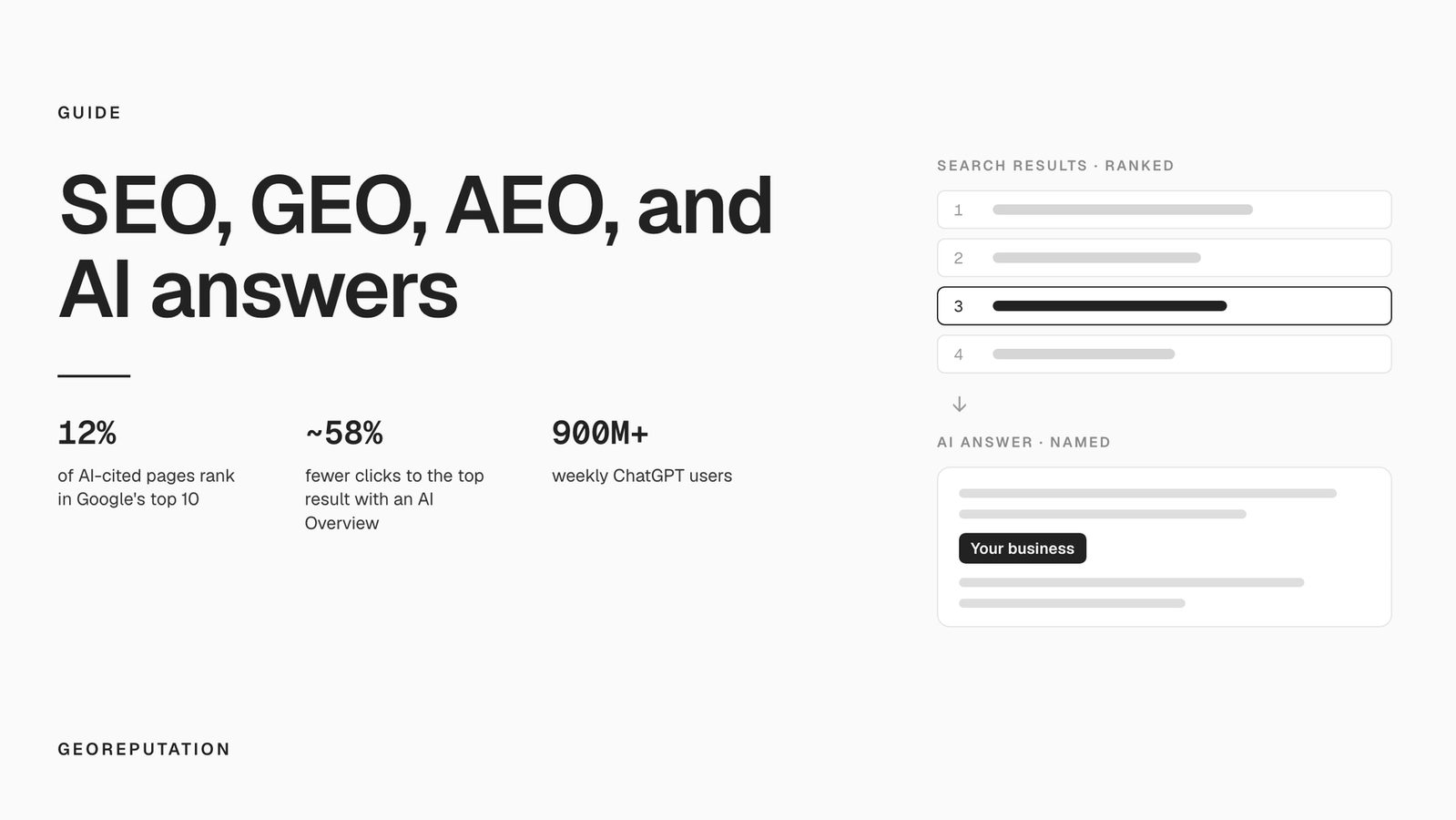
We get some version of this question all the time: what's the difference between SEO, GEO, and AEO, and do I actually need to care?
The short version: SEO gets your website ranked in a list of links. AEO and GEO get your business named inside the answer itself, whether that answer comes from Google's AI Overviews, ChatGPT, Perplexity, Gemini, or Microsoft Copilot.
The terms overlap more than most of the marketing around them lets on. What changed is where your customer reads the answer. Part of search is shifting from organic results toward AI-generated answers, and these acronyms are the industry's attempt to name that shift.
Below is what each term means, where it came from, and what the research says about how different they really are. Every stat links to its source.
At a glance
| Term | Stands for | The goal | Where it shows up |
|---|---|---|---|
| SEO | Search engine optimization | Rank your website in search results | Google and Bing's list of links |
| AEO | Answer engine optimization | Be the direct answer to a question | Featured snippets, voice assistants, and now AI answers |
| GEO | Generative engine optimization | Be cited or recommended in AI-generated answers | ChatGPT, Perplexity, Google AI Overviews and AI Mode, Copilot, and Gemini |
| LLMO / AIO / AI SEO | Large language model optimization, AI optimization | Same idea as GEO, different label | Same as GEO |
| AI visibility | The outcome, not a tactic | How often, and how, AI names your business | Everywhere AI answers questions |
SEO: ranking in the list
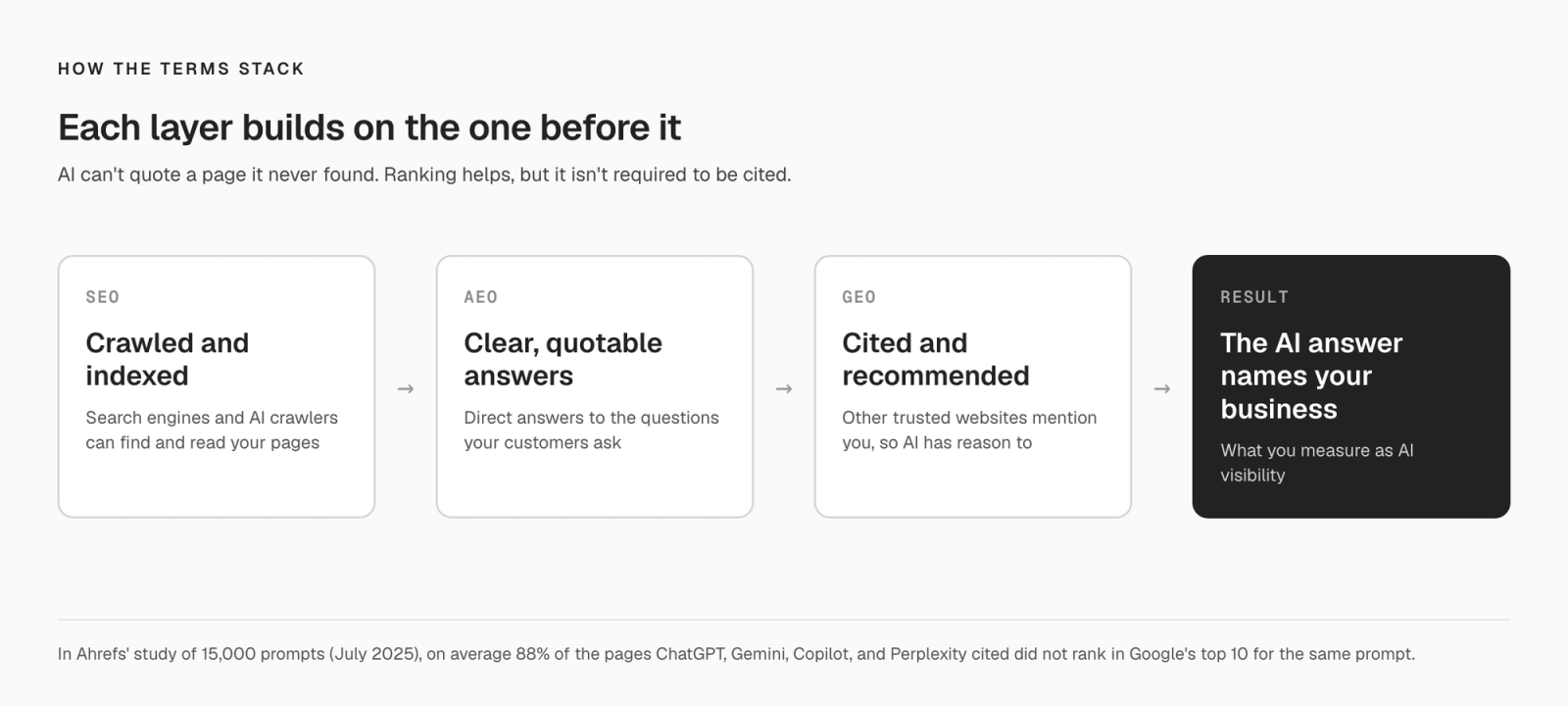
Search engine optimization is the practice of getting a web page to rank for a search. The basics haven't changed much. Search engines have to be able to crawl and index your site, your pages have to answer what the searcher asked, and links and mentions from other websites still signal authority.
The result is a position. You're third for "emergency plumber Austin," and the searcher decides whether to click.
AEO: being the answer
Answer engine optimization is older than ChatGPT. Search marketer Jason Barnard is often credited with the term, and Search Engine Watch covered it in February 2018 in "The rise of Answer Engine Optimization: Why voice search matters."[1]
"Answer engines" back then meant Google's featured snippets, knowledge panels, and voice assistants like Alexa and Siri. The goal was to be the one answer read aloud, not one of 10 blue links.
Today AEO is often used to mean the same thing as GEO. Some people prefer it because it doesn't get confused with "geo" as in geography.
GEO: being cited by generative AI
Generative engine optimization comes from a research paper. In November 2023, researchers from Princeton, IIT Delhi, and independent labs published "GEO: Generative Engine Optimization,"[2] later presented at the KDD 2024 conference.
They built a benchmark of 10,000 queries across 25 domains and tested how changes to a web page affected how visible it was inside AI-generated answers. A few findings are still useful starting points:
- Adding citations, quotations, and statistics was linked to the biggest gains, around 30% to 40% on their measures.
- Keyword stuffing, an old SEO trick, showed no meaningful improvement.
- Lower-ranked pages gained the most. With the "cite sources" method, a page ranked fifth in search saw its visibility rise 115.1%, while the top-ranked page's fell 30.3%.
The term went mainstream in 2025. New York Magazine's Intelligencer ran "SEO Is Dead. Say Hello to GEO"[3] in August 2025. We don't think SEO is dead, and the data below is why.
The rest of the alphabet
- LLMO (large language model optimization) and AI SEO: same goal as GEO, different label.
- AIO (AI optimization): also used for GEO. That gets confusing, because Google's AI Overviews are often shortened to AIO too.
- AI Overviews: the AI summary at the top of many Google results.
- AI Mode: Google's chat-style search, where the AI answer is the whole page.
- AI answers: the plain-English umbrella for all of it. When someone asks ChatGPT, Perplexity, Copilot, Gemini, or Google's AI a question and gets a written answer back, that's an AI answer.
- AI visibility: how often, where, and how favorably your business shows up in those answers. This is what you measure. GEO and AEO are what you do about it.
Are they actually different?
Google says no. Its July 2026 guide to generative AI features in Search[4] says optimizing for generative AI search is optimizing for the search experience, "and thus still SEO." The same guide says Google Search doesn't use llms.txt files and that no special schema is required for AI features.
The data pushes back. Ahrefs tested 15,000 long-tail prompts in July 2025[5]. Averaged across the four AIs it tested, only 12% of the URLs they cited also ranked in Google's top 10 for the same prompt. Perplexity overlapped the most, at 28.6%. ChatGPT, Gemini, and Copilot each landed between 6.1% and 8.6%.
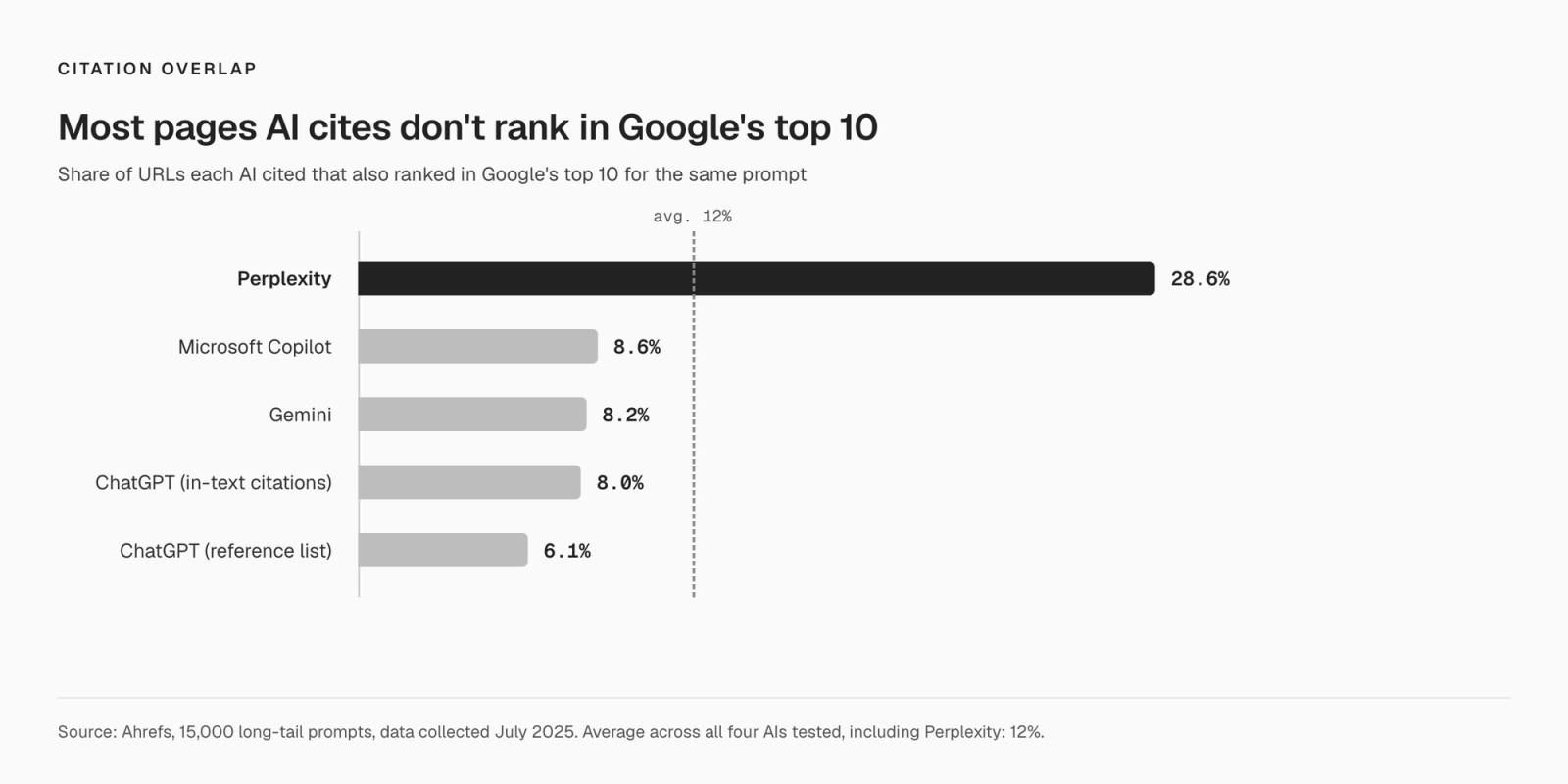
So we think both things are true. The foundation is shared. Pages AI can find, clear answers, and a reputation other websites talk about help you everywhere. But ranking well on Google doesn't mean AI will name you. AI systems split a question into several related searches (Google calls this "query fan-out"[4]), pull from many sources, and then write their own answer.
Where each AI gets its sources
| AI | Where it looks | What to check |
|---|---|---|
| Google AI Overviews and AI Mode | Google's own search index, using query fan-out | You show up for the question and its follow-ups |
| ChatGPT search | Bing's index plus OpenAI's own crawler, OAI-SearchBot | You're indexed in Bing Webmaster Tools and don't block OAI-SearchBot |
| Gemini | Google Search, with inline citations | Same as Google |
| Microsoft Copilot | Bing | Your citations in Bing's AI Performance report |
| Perplexity | Its own crawler and ranking | Perplexity hasn't published how it ranks sources |
Sources for the table: Google's guide[4], OpenAI's crawler documentation[6], Yoast on ChatGPT and Bing[7], Google's Gemini documentation[8], and Bing's Webmaster blog[9].
Where we land: AI visibility first. SEO compounds. SEO is the layer underneath that keeps paying off. AI visibility is a separate thing to measure, because the answer your customer reads is no longer the list of links.
For how this plays out for a real business, including one that ranks first on Google and still gets left out of the AI answer, see Molly's SEO to GEO: A Guide to Search Strategy in the AI Era.
Why this matters now
The way people find businesses is changing, and the numbers are big enough to take seriously:
- ChatGPT has more than 900 million weekly active users, according to OpenAI in February 2026[10].
- Google reported in July 2026[11] that AI Mode had passed 1 billion monthly active users and the Gemini app had reached 950 million.
- Pew Research tracked the real browsing of 900 US adults[12] in March 2025. When an AI summary appeared, people clicked a regular result on 8% of visits, compared with 15% when there was no summary. They clicked a link inside the summary on 1% of visits.
Ahrefs estimated[13] that an AI Overview cuts clicks to the top-ranking page by about 58%, compared with what it would get without one (300,000 keywords, December 2025).
On the other side, Google still sends far more traffic to websites than AI chat does. Across 76,000 websites, Ahrefs found Google sent about 190 times more traffic than ChatGPT[14].
So we wouldn't tell anyone to abandon SEO. The practical move is to measure both: where you rank, and whether AI names you.
What the research suggests is worth testing
None of these are guarantees. AI answers change from one run to the next, so we treat everything below as a test and measure the result over many runs.
- Keep the SEO basics solid. Google says its AI features pull pages from its normal search index. If you can't be crawled and indexed, you can't be cited[4].
- Don't forget Bing. ChatGPT search and Copilot lean on Bing's index. Check that your key pages are indexed in Bing Webmaster Tools, and that your robots.txt doesn't block OAI-SearchBot[6] unless you mean it to. OpenAI says sites that block it won't be shown in ChatGPT search answers.
- Cover the follow-up questions. Because AI splits one question into several related searches (query fan-out[4]), a page that also answers the questions around the main one may give it more to pull from.
- Be present on the websites AI quotes. In a study of 75,000 brands, Ahrefs found brand mentions across the web correlated with AI visibility at 0.664, compared with 0.218 for backlinks[15]. In its 2026 update, YouTube mentions were the strongest single signal[16]. That's correlation, not proof, but it's a clear signal to test.
- Make your content easy to quote. The original GEO paper[2] found statistics, citations, and quotations were linked to the biggest gains. Specifics beat adjectives.
- Skip the rituals. Google says you don't need llms.txt, special markup, or content chopped into tiny chunks for its AI features[4].
- Turn on the free reports. Bing Webmaster Tools added an AI Performance report[9] in February 2026 that shows your citations in Copilot and Bing's AI summaries. Google Search Console's generative AI performance report[17] reached all websites in August 2026. It shows impressions in AI Overviews and AI Mode, but not clicks or queries. The same rollout added a setting that lets a site opt out of those AI features[18], if that's ever what you want.
How to measure AI visibility honestly
Ask ChatGPT the same question twice and you may get two different lists. SparkToro and Gumshoe.ai had 600 volunteers run 12 prompts 2,961 times across ChatGPT, Claude, and Google's AI. There was less than a 1 in 100 chance of getting the same list of brands twice[19], and about a 1 in 1,000 chance of getting them in the same order.
That lines up with how we built GeoReputation. A single "ranking position in AI" doesn't mean much. What holds up is visibility across a set of prompts (the questions we ask each AI platform every week), run again and again, on each platform your customers use. Every number should trace back to a specific prompt, a specific model, and the full response it gave, so you can read it yourself instead of trusting a score.
FAQ
Is GEO replacing SEO?
No. SEO is still the foundation, and Google still sends the most traffic to websites. GEO adds a second question: when AI answers, does it name you?
Is AEO the same as GEO?
In 2026, mostly yes. AEO started with featured snippets and voice search around 2017 and 2018. GEO started with a 2023 research paper on generative AI. Most people now use the two terms interchangeably.
What's the difference between AI Overviews and AI Mode?
AI Overviews is the summary at the top of a normal Google results page. AI Mode is a separate, chat-style search where the AI answer is the whole page.
Does ranking #1 on Google mean ChatGPT will recommend me?
Not necessarily. In Ahrefs' July 2025 study[5], only 8.0% of ChatGPT's in-text citations ranked in Google's top 10 for the same prompt.
How do I get my business mentioned by ChatGPT?
Nobody can guarantee it, but research suggests a few things may help. Make sure your site is indexed in Bing and doesn't block OpenAI's search crawler. Answer customer questions clearly and specifically. Earn mentions on other trusted websites, since brand mentions across the web are associated with AI visibility[15]. Then test it across many prompts, because answers change from run to run.
Do I need an llms.txt file?
Not for Google. Google says Google Search doesn't use it[4]. Other AI services may read it, and it doesn't hurt.
What does LLMO mean?
LLMO stands for large language model optimization. It means the same thing as GEO: improving how AI like ChatGPT and Gemini describes and cites your business.
How do AI models describe your business? Exact prompts. Full responses. Tracked over time. Run a free scan
References
- [1]The rise of Answer Engine Optimization: Why voice search matters — Search Engine Watchhttps://www.searchenginewatch.com/2018/02/07/the-rise-of-answer-engine-optimization-why-voice-search-matters/Accessed Sep 23, 2026
- [2]GEO: Generative Engine Optimization — ACM SIGKDD 2024 (arXiv)https://arxiv.org/abs/2311.09735Accessed Sep 23, 2026
- [3]SEO Is Dead. Say Hello to GEO. — Intelligencer, New York Magazinehttps://nymag.com/intelligencer/article/seo-is-dead-say-hello-to-geo.htmlAccessed Sep 23, 2026
- [4]Google's guide to optimizing for generative AI features on Google Search — Google Search Centralhttps://developers.google.com/search/docs/fundamentals/ai-optimization-guideAccessed Sep 23, 2026
- [5]Only 12% of AI cited URLs rank in Google's top 10 for the original prompt — Ahrefshttps://ahrefs.com/blog/ai-search-overlap/Accessed Sep 23, 2026
- [6]Overview of OpenAI crawlers — OpenAIhttps://developers.openai.com/api/docs/botsAccessed Sep 23, 2026
- [7]What is ChatGPT Search (and how does it use Bing data)? — Yoasthttps://yoast.com/chatgpt-search/Accessed Sep 23, 2026
- [8]Grounding with Google Search — Google AI for Developershttps://ai.google.dev/gemini-api/docs/google-searchAccessed Sep 23, 2026
- [9]Introducing AI Performance in Bing Webmaster Tools — Bing Webmaster Bloghttps://blogs.bing.com/webmaster/February-2026/Introducing-AI-Performance-in-Bing-Webmaster-Tools-Public-PreviewAccessed Sep 23, 2026
- [10]ChatGPT reaches 900M weekly active users — TechCrunchhttps://techcrunch.com/2026/02/27/chatgpt-reaches-900m-weekly-active-users/Accessed Sep 23, 2026
- [11]Alphabet Q2 2026 earnings call: remarks from our CEO — Googlehttps://blog.google/company-news/inside-google/message-ceo/alphabet-earnings-q2-2026/Accessed Sep 23, 2026
- [12]Google users are less likely to click on links when an AI summary appears in the results — Pew Research Centerhttps://www.pewresearch.org/short-reads/2025/07/22/google-users-are-less-likely-to-click-on-links-when-an-ai-summary-appears-in-the-results/Accessed Sep 23, 2026
- [13]AI Overviews reduce clicks (update) — Ahrefshttps://ahrefs.com/blog/ai-overviews-reduce-clicks-updateAccessed Sep 23, 2026
- [14]ChatGPT has 12% of Google's search volume but Google sends 190x more traffic to websites — Ahrefshttps://ahrefs.com/blog/chatgpt-has-12-percent-of-googles-search-volume/Accessed Sep 23, 2026
- [15]An analysis of AI Overview brand visibility factors (75K brands studied) — Ahrefshttps://ahrefs.com/blog/ai-overview-brand-correlation/Accessed Sep 23, 2026
- [16]YouTube mentions are the top signal for AI brand visibility — The Next Webhttps://thenextweb.com/news/ahrefs-youtube-mentions-ai-visibility-brand-searchAccessed Sep 23, 2026
- [17]Generative AI performance report (Search) — Search Console Helphttps://support.google.com/webmasters/answer/16984139?hl=enAccessed Sep 23, 2026
- [18]Google Search Console AI reports rolled out worldwide — Search Engine Journalhttps://www.searchenginejournal.com/google-search-console-ai-reports-rolled-out-worldwide/587836/Accessed Sep 23, 2026
- [19]AIs are highly inconsistent when recommending brands or products — SparkTorohttps://sparktoro.com/blog/new-research-ais-are-highly-inconsistent-when-recommending-brands-or-products-marketers-should-take-care-when-tracking-ai-visibility/Accessed Sep 23, 2026
About Dan Johnson
Dan Johnson is the co-founder of GeoReputation, where he handles the engineering. Posts on this blog are usually grounded in data pulled live from the platform.